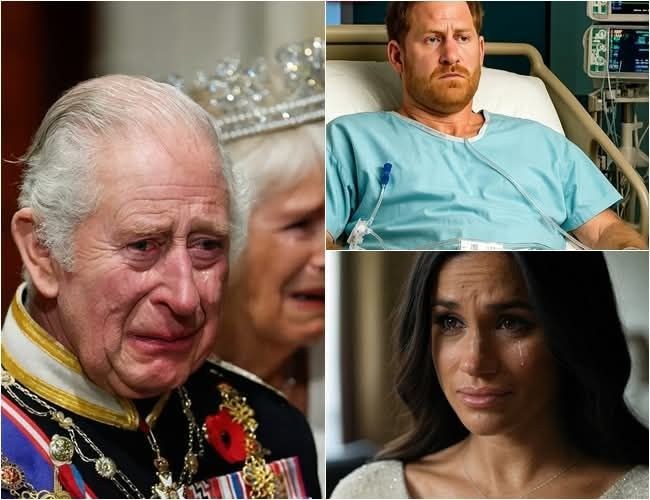


The hallowed, velvet-draped corridors of Buckingham Palace have long been the keepers of some of history’s most guarded secrets, but even the thickest stone walls cannot always contain the weight of a guilty conscience. In a revelation that has sent shockwaves through the Commonwealth and beyond, reports have emerged of a profound, private reckoning between King Charles III and his heir, Prince William. Sources close to the inner sanctum of the House of Windsor describe a moment of raw, unprecedented vulnerability—a scene that stands in stark contrast to the rigid “stiff upper lip” traditionally associated with the British monarchy.
During an intimate meeting between father and son, the King reportedly reached out to grasp William’s hand, his eyes reflecting the heavy burden of a crown that has often felt more like a leaden weight than a golden honor. With a voice fractured by age and regret, Charles is said to have uttered a sentence that many believed would never be spoken within the royal household: “I’m sorry, my son. I’m sorry for your mother.”
This brief, haunting apology has reignited a global conversation about the legacy of Diana, Princess of Wales, whose life and death remain the most scrutinized chapters in modern royal history. Since that catastrophic night in the Pont de l’Alma tunnel in 1997, the world has been haunted by the “what ifs” of Diana’s fate. While official investigations concluded that the car accident was the result of a tragic combination of paparazzi pursuit and a driver under the influence, the public imagination has never quite let go of the idea that Diana was a woman chased to her end by the very institution she had married into.
For Prince William, who was only fifteen when he walked behind his mother’s coffin through the somber streets of London, these words from his father represent a seismic shift in the familial narrative. For decades, the royal family has maintained a policy of silence regarding the tumultuous years of the “War of the Waleses.” The standard operating procedure was to move forward, to modernize, and to leave the ghosts of the nineties in the rearview mirror. However, Charles’s reported confession suggests that the King has come to realize that the monarchy cannot truly step into the future without properly addressing the trauma of its past.
The apology, though simple in its phrasing, is layered with complex meaning. It is viewed by many as an acknowledgment of the emotional isolation Diana endured during her tenure as the Princess of Wales. Diana famously described her life within the palace as a “cold house,” where she was subjected to constant surveillance, gaslighting, and the suffocating pressure to conform to an archaic mold. By apologizing to William, Charles appears to be taking personal accountability for the role he played in that environment—the lack of support, the infidelity that haunted their marriage, and the institutional coldness that left a vulnerable young woman feeling like a prisoner in a gilded cage.
Furthermore, this moment of reconciliation carries immense weight for the stability of the crown. The relationship between Charles and William has often been described as professional and respectful, yet occasionally strained by the shadows of the past. William, who has worked tirelessly to honor his mother’s memory through his charitable work and his approach to parenting, has always been the keeper of Diana’s flame. For the King to finally validate William’s pain—and the injustice suffered by his mother—is a move that could bridge the generational divide within the family. It signals that Charles III intends to be a “healing king,” one who is unafraid to dismantle the wall of silence that often protects the institution at the cost of the individuals within it.
The confession also touches upon the darker undercurrents of the Diana tragedy. While it is unlikely that Charles was referring to any of the more extreme conspiracy theories that have circulated for twenty-seven years, his remorse reignites the debate over the royal family’s “duty of care.” The apology seems to concede that the Palace failed to protect Diana—not just from the paparazzi on that final night in Paris, but from the psychological and emotional toll of her royal life. It is a recognition that the “Firm” prioritized its own survival and reputation over the well-being of a woman who had become its most popular and charismatic asset.
Public reaction to the news has been a mixture of vindication and skepticism. For those who have remained “Team Diana” through the decades, the apology feels like a long-overdue admission of guilt. They see it as a victory for the Princess’s memory, a sign that her truth has finally penetrated the highest level of the British establishment. For others, particularly critics of the monarchy, the timing is seen as a strategic move to soften the King’s image during a period of significant transition and health challenges within the royal family. Regardless of the motivation, the impact of the words remains undeniable.
Within the palace, the atmosphere is said to be one of quiet reflection. The King, now in his mid-seventies and facing the twilight of his reign, is reportedly preoccupied with his legacy.1 He is acutely aware that history’s judgment of his time on the throne will be inextricably linked to his treatment of the woman who would have been his queen. By seeking forgiveness from the son who looks so much like her, Charles is attempting to settle a debt that has been outstanding for nearly thirty years.
As Prince William prepares for his own eventual ascension to the throne, this apology may serve as a foundational moment for his future reign. It allows him to carry his mother’s memory forward without the corrosive bitterness that comes from unacknowledged wrongs. It allows him to lead a monarchy that is more transparent, more empathetic, and more human than the one his mother encountered in 1981.
The story of Charles and Diana has always been a tragedy of Shakespearean proportions—a tale of duty versus desire, tradition versus modernity, and the high cost of a crown. But in this quiet, reported moment between a father and a son, the tragedy finds a note of grace. The words “I’m sorry for your mother” do not change the events of 1997, nor do they bring Diana back to the sons who loved her so fiercely. What they do, however, is provide a sense of closure that has been missing for over a quarter of a century. They represent the tearing down of a curtain of denial and the beginning of a genuine healing process for the House of Windsor. The King has spoken, the heir has listened, and the ghost of the People’s Princess may finally find a modicum of peace within the halls of the Palace.