My name is Erin. I’m 40 years old, and three weeks ago, my life split cleanly down the middle.




My daughter Lily was ten. She was bright, stubborn, endlessly curious, and impossibly kind. On a rainy Saturday morning, she buckled herself into the passenger seat, grinning as she talked about the sunflower she planned to finish at her weekend art class. My husband Daniel was driving, teasing her with promises of hot chocolate afterward.
They never made it.

A pickup truck lost control on a slick curve, crossed the divider, and slammed into their car. The impact crushed the passenger side. Lily died instantly.
Daniel survived.
His body was broken—ribs fractured, lungs bruised, spine damaged—but he lived. He spent two weeks in the ICU, drifting in and out of consciousness. When he finally opened his eyes, he didn’t ask where he was or how bad his injuries were. He whispered one word.
“Lily?”
Then he collapsed into sobs so violent I thought it might kill him—and part of me wished it would, because watching him live with that pain felt unbearable.
When Daniel came home, he moved like someone already half-gone. He barely spoke. He blamed himself for choosing that road, for not seeing the truck, for surviving when she didn’t. Our house felt hollow, like a stage after the actors had left.
Lily’s room stayed untouched. Her art supplies were scattered across her desk. Her sunflower sketch sat half-colored. Toys lay where she’d dropped them. Fairy lights still glowed softly at night. On her nightstand rested a bracelet she’d been making for me, unfinished.
I drifted past her door like a ghost, half-expecting her to jump out and shout “Boo!” She never did.
I made coffee I didn’t drink. I sat in chairs I didn’t notice. I slept only when my body gave up. Existing was the best I could manage.
The police had taken Lily’s belongings from the crash as evidence. Sitting in a gray office, I signed a form listing every item: her backpack, her glitter sneakers, her sunflower sketchbook, her purple headband—and her yellow sweater.
That sweater broke me.
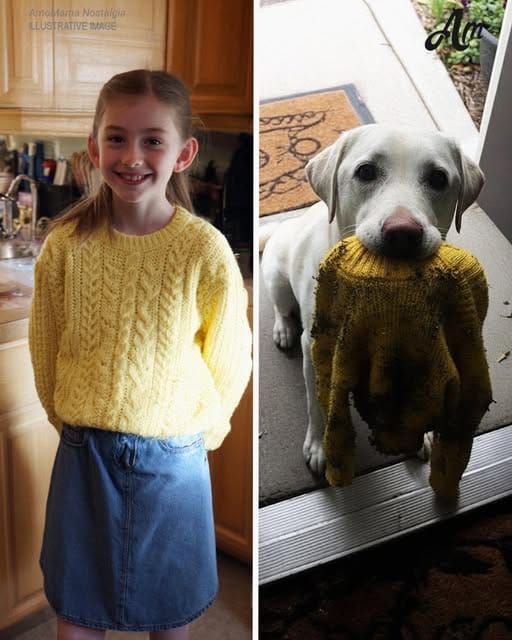
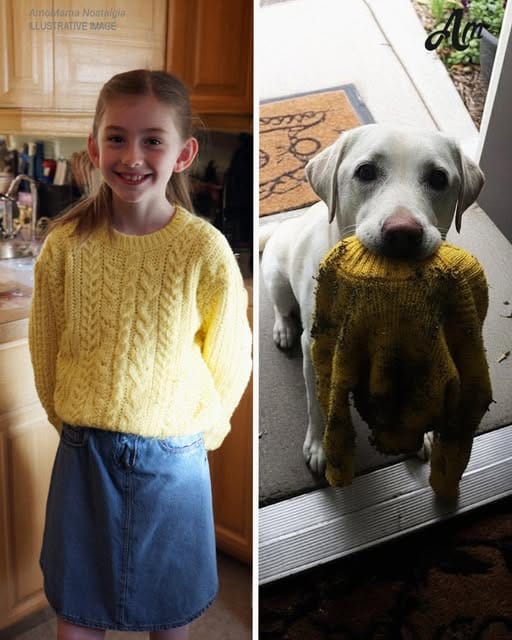
It was soft, bright yellow, with tiny pearl buttons. She wore it almost every weekend. It made her look like a walking sunbeam. It smelled like crayons, vanilla shampoo, and peanut butter from school lunches. And now it was sealed away in a bag I’d never see.
One foggy morning, I sat at the kitchen table wearing Daniel’s oversized sweatshirt, hugging a mug that said “Best Mom Ever,” a Mother’s Day gift from Lily. I hadn’t drunk from it since she died. That morning, I needed something that still felt like her.
Daniel was asleep upstairs, breathing heavily, haunted even in rest. I stared out the window at the fog curling across the backyard when I heard it.
Scratch. Scratch. Scratch.
It wasn’t Baxter’s usual bark. It was frantic, desperate. Our dog—a golden retriever mix who’d been Lily’s shadow since she was five—was clawing at the back door.
“Baxter?” I called.
The scratching paused, then came a sharp bark—the one he used only when something was wrong.
I opened the door.
He stood there, eyes wide, ears alert, tail stiff. In his mouth was something yellow.
My heart stalled.
He stepped forward and gently placed it at my feet.
It was Lily’s sweater.
The same one she’d worn so often. The same color. The same fabric.
My legs nearly gave out. “This… this isn’t possible,” I whispered.
When I reached for it, Baxter grabbed it again, then turned sharply toward the yard and bolted.
“Baxter!” I yelled, shoving my feet into clogs and chasing him without a jacket.
He slipped through a gap in the fence—the same one Lily used to squeeze through to reach the empty lot next door. I followed, clutching the sweater, heart pounding.
Baxter kept stopping, looking back to make sure I was still there.
He led me to an old shed at the far edge of the lot. The door hung crooked on one hinge. He stopped inside the doorway and waited.
Inside, sunlight filtered through warped boards. The air smelled of dust and damp wood.
Then I saw it.
In the corner was a nest made of clothing—soft, familiar clothing. Lily’s purple scarf. Her blue hoodie. A white cardigan she hadn’t worn in years.
Curled into the pile was a calico cat, purring softly. Three tiny kittens pressed against her belly, no bigger than teacups.
Baxter dropped the yellow sweater beside them. The kittens immediately crawled toward it.
And suddenly, I understood.
This wasn’t the sweater from the accident. It was the second one—the backup I’d bought because Lily insisted she needed two. I hadn’t even noticed it was missing.
I sank to my knees, choking on a sob. Lily had been sneaking out here. She’d found the pregnant cat weeks ago. She’d brought food, water, and her own clothes to keep them warm. She’d built this nest quietly, lovingly, without telling anyone.
The cat looked at me calmly, as if she knew exactly who I was.
Baxter wagged his tail once.
I carried them all home.
I made a nest in a laundry basket near Lily’s favorite chair. Baxter lay beside it like a guard. When Daniel came downstairs and saw them, something shifted in his eyes—not relief, not peace, but a small lifting of the darkness.
“She had the biggest heart,” he whispered.
“She still does,” I said.
We kept them all.
And for the first time since Lily died, I had a reason to wake up each morning. To care. To love. To continue something she started.
That night, I slept without nightmares.
And in the quiet morning light, with tiny heartbeats stirring downstairs, it felt—for just a moment—like Lily was still here. Not in sorrow. But in kindness.