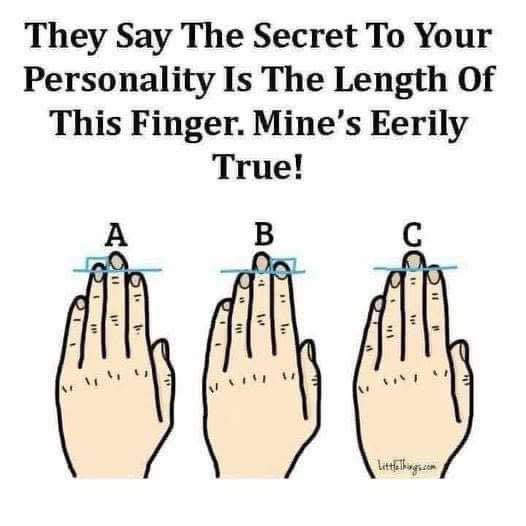
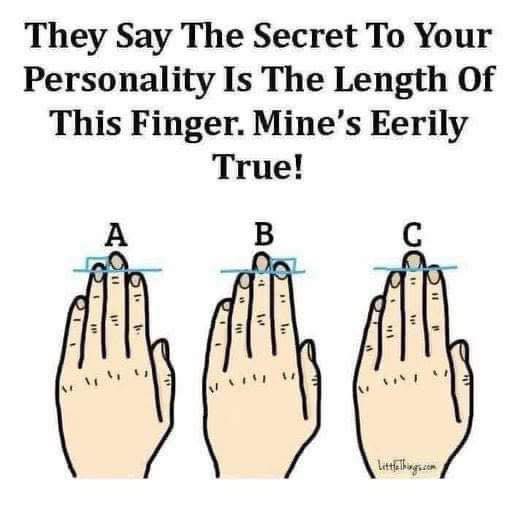
In various pseudoscientific theories, especially those concerning palmistry or hand analysis, it is posited that an individual’s personality traits are ‘determined’ by the length of their fingers.






Personality is shaped by a multifaceted combination of genetic, environmental, and psychological influences, and cannot be accurately assessed through physical attributes such as finger length. Nevertheless, some individuals hold a different perspective.
According to a pseudoscientific notion known as the ‘digit ratio,’ which particularly emphasizes the ratio between the index finger (2D) and the ring finger (4D), certain elements of a person’s personality can be readily inferred.

Some of the interpretations are as follows:
- Longer Ring Finger (Low 2D:4D Ratio): Having longer ring finger is often associated with people who are believed to be risk-takers, assertive, and have high self-esteem. Further, these people are believed to be competitive, ambitious, and outgoing.
- Longer Index Finger (High 2D:4D Ratio): Having longer index finger is associated with people who are compassionate, emphatic, communicative, and nurturing. These individuals tend to avoid conflicts.
- Equal Length: These individuals might display a combination of assertiveness and empathy, showing both competitive and cooperative behavior depending on the circumstances.

According to Science, the notion that the lengths of fingers can indicate significant personality traits originates from evolutionary biologist John Manning, who is currently affiliated with Swansea University. His research has led to the inspiration of over 1,400 studies within a span of just over two decades, establishing connections between finger ratios and aspects such as personality, cognitive skills, and susceptibility to diseases.
Moreover, the magazine notes that the concept of finger ratios was introduced in the late 1950s when researchers established a correlation between prenatal testosterone levels and brain development as well as behavior. Given the risks associated with fetal hormone sampling, scientists have adopted finger ratios as a non-invasive method to investigate traits that are influenced by prenatal hormones, including aggression and sexual orientation.
Tell us what you think about this!